Portfolio

Case studies

GTM strategy, product launches, campaign development, and sales enablement across B2B and B2C.

$700M+
Revenue Impact
460M
Campaign Impressions
9
Years PMM

How I Work: AI as Operating System

Most marketers use AI as a writing tool. I use it as an operating system. One person operating with the context of a full team.

The bottleneck in PMM isn't writing speed, it's context. Knowing what shipped, what customers said, what competitors changed, what the sales team is struggling with. That context is scattered across Slack, meeting transcripts, CRM notes, and product docs.

I build systems that pull all of that together automatically. Semantic search across thousands of documents. Daily briefings generated from meeting transcripts and Slack. Competitive monitoring that flags changes before I have to look for them.

This isn't about replacing thinking with AI. It's about eliminating the hours of context-gathering that sit between you and the actual work. The diagnostic, the positioning, the launch plan, the CEO briefing: that's the real work. Everything else is infrastructure, and infrastructure should be automated.


Blinq · Senior PMM
AI-Native GTM Internal Adoption Knowledge Systems

Founding the AI Working Group: Making the Whole Company AI-Native From Inside PMM

Product, sales, growth and engineering all had AI curiosity but no shared workflow. I founded the AI Working Group, ran a biweekly forum across functions, and built a knowledge base of customer calls, competitor intel, and product language that the full sales team uses daily.

Overview

AI was talked about in every meeting but nobody had a way to share what was working. Sales was rebuilding the same competitive answer every week. Product was reading customer calls a month after sales had heard them. I treated this as a PMM problem before it was a tooling problem: the context wasn't moving fast enough across the company.

What I Did

  • Founded the AI Working Group. Biweekly forum across product, sales, growth, and engineering. Four sessions across three months. Each one centred on a single live demo from someone shipping with AI internally, not vendor pitches or theory
  • Built the GTM Knowledge Base. Aggregated customer call transcripts, competitor intel, product language, and ICP notes into one searchable source. Made it accessible through the AI tools the team was already using, so the friction to query was zero
  • Got the full sales team using it daily. Partnered with RevOps to physically set up local AI access on every rep's machine, paired the launch with three concrete use cases (deal queries, competitive answers, email drafting), and ran enablement against the use cases not the tool
  • Taught the practice, not the product. Sessions focused on how to write a brief for an AI, how to share a working prompt, how to think about context as an asset. The bar I set: every working AI workflow needs to ship as a doc someone else can pick up
  • Connected the work to GTM outputs. Used the same Knowledge Base to power customer interviews, competitive battlecard updates, and launch messaging. PMM moved at the velocity of a larger team without adding headcount

Challenges and Solutions

  • "Why is this PMM's job?" Treated AI adoption as a context problem and PMM owns context. Framed every session around a GTM output (a better sales answer, a sharper customer story, a faster launch) rather than the tool itself
  • Adoption past the early enthusiasts. Built the Knowledge Base around the use cases sales already had pain on (competitive, deal context, email crafting) instead of asking them to invent a new workflow. The first wins came from sales reps answering competitor questions in seconds, not from anyone "learning AI"
  • Demo culture vs. operating culture. Pushed every session toward a shippable artifact (a brief template, a working prompt, a doc with examples) so the group built operating capability, not a wow reel

Results

  • Full 10-person sales team using the GTM Knowledge Base daily for competitive queries, deal context, and outbound copy
  • Cross-functional adoption: product, growth, and engineering all running demos in the same forum within three months
  • Positioned internally as the context architect for non-technical teams, with PMM treated as the system that moves the company's customer context

Delivered

GTM Knowledge Base (live) AI Working Group (4 sessions) Sales enablement program Use-case playbooks Brief template + working prompts
Gamma · Take-home
AI-Native PMM Positioning Buying Committee

Enterprise GTM Strategy: From 40K Teams of 3 to 1K Teams of 10+

Gamma's brief gave me four personas and a growth target. I ran original primary research with sales enablement leaders at Mastercard, UpGuard, Deel, and Rithum, then pushed past the four personas to name the real enterprise champion: not the VP from the brief, the enablement leader who actually owns the rollout.

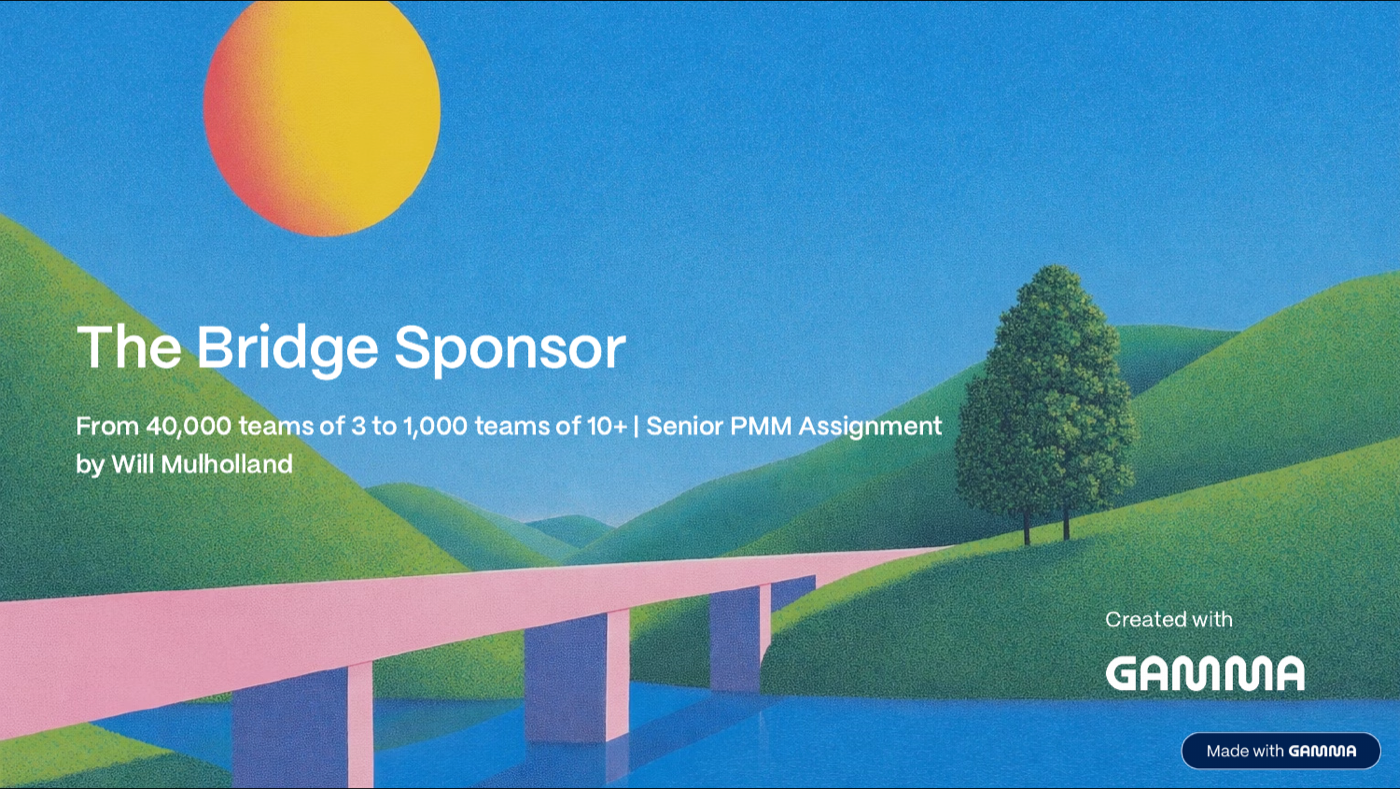
The Bridge Sponsor - Senior PMM Take-Home for Gamma - cover slide
Open the full deck (PDF) →

Overview

Gamma sent me a Senior PMM take-home assignment. The brief: how to take Gamma from 40,000 teams of 3 users to 1,000 teams of 10+ users, with four pre-defined personas. The work product was a full strategic deck covering positioning, persona reframing, pricing research methodology, and the GTM motion. The Bridge Sponsor is the framing I built for it.

What I Did

  • Ran original primary research before touching the personas. Interviewed Kevin Bogdanov (ex-Indeed and Salesforce sales enablement leader) on how enablement teams actually buy AI content tools. Validated the pattern through conversations with sales enablement and commercial leaders at Mastercard, UpGuard, Deel, and Rithum. Cross-referenced with Gartner buying-committee research and McKinsey adoption data
  • Pushed past the four personas in the brief. The real enterprise buyer wasn't the VP Gamma had named, it was the enablement leader who feels the pain, translates product into content, runs pilots, and proves ROI before the VP signs the PO. Reframed the persona model around that insight
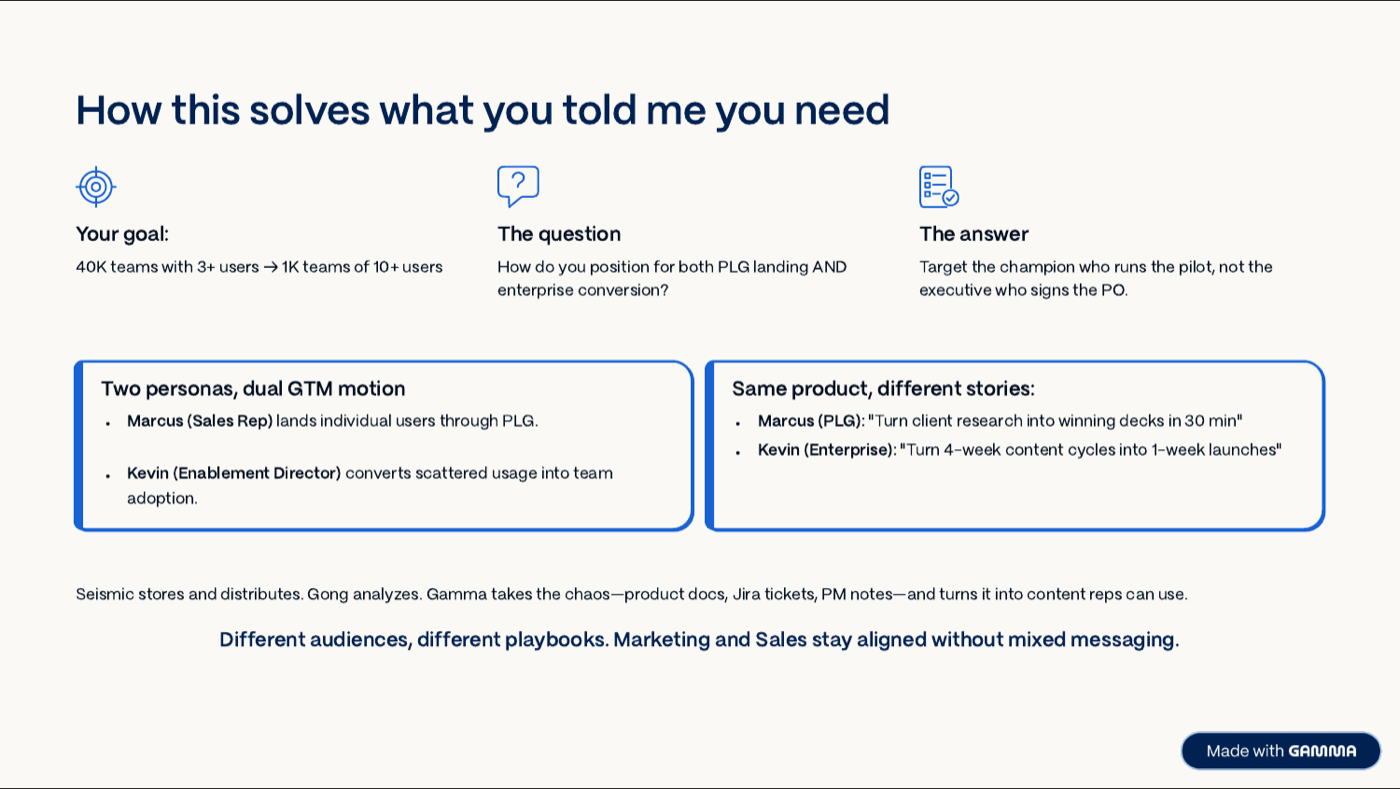
  • Built a two-persona dual GTM motion. Marcus (sales rep) lands individual users through PLG, Kevin (Enablement Director) converts scattered usage into team adoption. Same product, two stories, no mixed messaging between marketing and sales
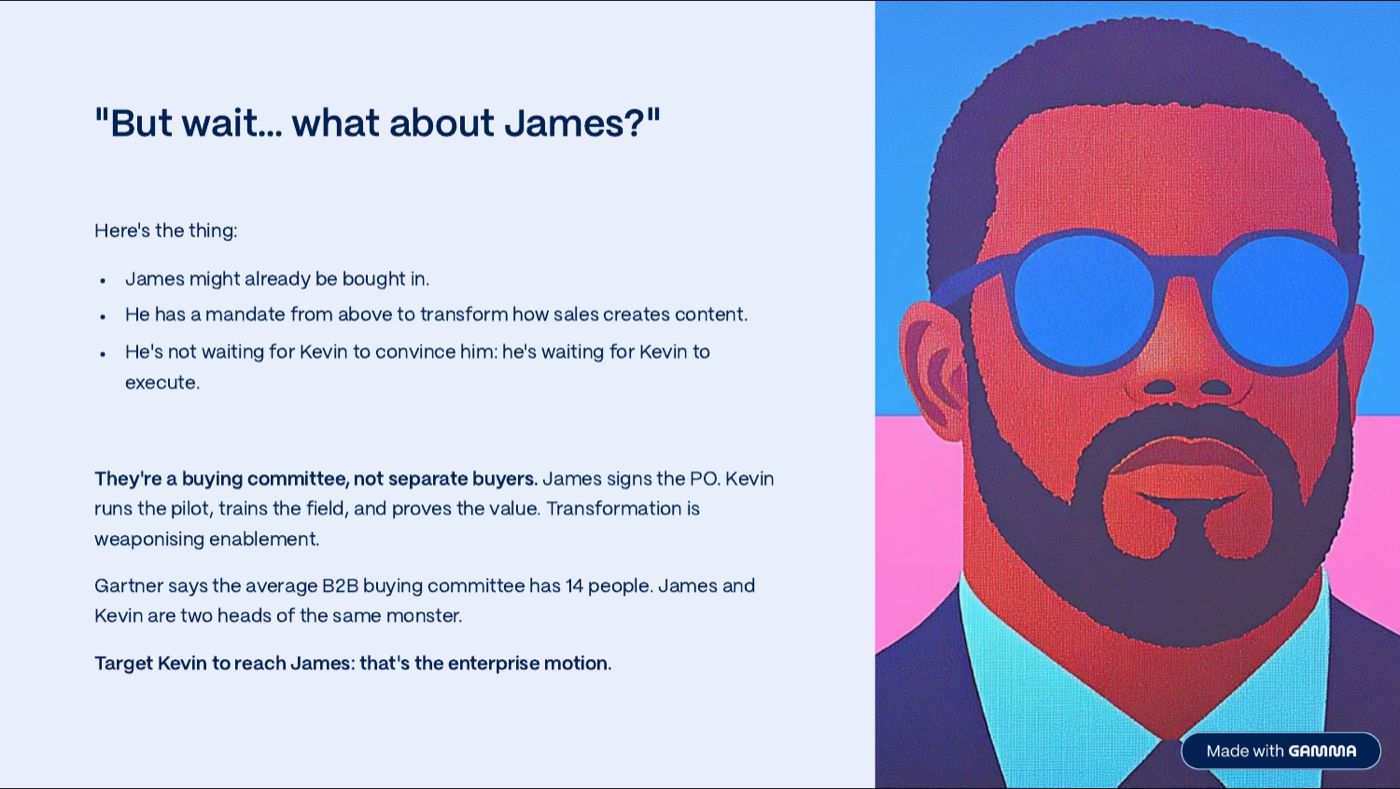
  • Named the buying-committee dynamic. "Target Kevin to reach James, that's the enterprise motion." Gartner says the average B2B buying committee has 14 people. James (VP) signs the PO. Kevin (enablement) runs the pilot, trains the field, proves the value. Transformation is weaponising enablement
  • Designed two parallel pricing-research tracks. Van Westendorp price sensitivity research with two competing hypotheses: is complexity killing conversion (simplify 6 plans to 4), or is credit confusion the blocker (transparency calculator showing ROI upfront). Test both, measure what works, no more guessing
  • Anchored positioning on a category claim. "Gamma is the AI creation layer for sales enablement." Used April Dunford's framework on how market category shapes buyer perception. Seismic stores and distributes, Gong analyses, Gamma creates. Reduces surface area by integrating with what exists rather than competing for new platform real estate

The Strategic Reframe

But wait - what about James? - buying committee analysis slide

The brief named the VP as the decision-maker. The research said otherwise. Enterprise tools get hired by the enablement leader and approved by the VP after the leader builds the case. Targeting James directly bypasses the person who feels the pain and runs the pilot. Targeting Kevin reaches both.

The Dual Motion

Two personas, dual GTM motion - PLG entry plus enterprise conversion

Marcus (PLG entry) and Kevin (enterprise conversion) are two heads of the same monster. Same product, different stories. Marcus message: "Turn client research into winning decks in 30 minutes." Kevin message: "Turn 4-week content cycles into 1-week launches." Marketing and sales stay aligned because the messaging is engineered for the layer they own.

Delivered

33-slide strategic deck (visual deck via Gamma) Primary research synthesis Persona reframe + buying committee map Dual-motion GTM playbook Pricing research test design (Van Westendorp) Category positioning thesis

Evidence

Blinq · Senior PMM
GTM Strategy Research Sales Enablement

GTM From Scratch: Diagnosing an 81% Activation Gap and Rebuilding the Go-to-Market

Blinq's event lead capture product had 1,715 workspaces but 81% had zero credit usage. No onboarding, no documentation, no structured handoff from sales. I ran a full diagnostic and built the GTM plan that became the company's #1 priority.

Blinq Event Lead Capture product demo

Overview

Blinq had shipped a full event lead capture product (scanner + AI enrichment + CRM sync + campaigns) but had no go-to-market motion behind it. I pulled the usage data across all 1,715 workspaces and mapped the actual distribution. Then ran 10+ stakeholder interviews across sales, customer success, and growth.

My Role

Before writing a single asset, I ran the diagnostic:

  • Pulled and analysed full usage data: 81% of workspaces had zero credit activity, zero workspaces hit the paid tier
  • Interviewed 10+ stakeholders across sales, CS, and growth to validate what the data showed
  • Discovered the real competitor wasn't Popl or Mobly (SaaS tools). It was the badge scanner included with every conference. 95% of event floors use them
  • Identified that every closed deal was an add-on to an existing account. No standalone demand existed
  • Reframed the ICP from "event managers" to teams running 10+ events/year without a dedicated solution

Built an 8-initiative GTM plan sequenced by what would unblock the most downstream:

  • Structured onboarding flow to close the sale-to-activation gap
  • "One consistent tool" value prop to counter the "we already have Cvent" objection
  • Training materials so sales could actually demo the product (they couldn't before)
  • New competitive battlecard with talk tracks built from Gong transcripts, G2, Capterra, and Reddit reviews

Challenges and Solutions

  • The "Event" framing was limiting. Customers connected it to conferences only. Repositioned around the 100-200 person regional event as the entry wedge (no badge provider, no hardware, Blinq wins on simplicity)
  • Zero standalone demand. Shifted entire GTM from demand gen to activation-first. If solved, 1,715 workspaces become 1,715 trials with 10% conversion = 140+ pipeline deals

Results

The diagnostic became the company's top priority. CEO adopted the GTM plan as the roadmap for Event Lead Capture, shifting from demand gen to activation-first. Shipped all 8 initiatives within the first quarter.

Delivered

GTM strategy doc Webpage copy (live) 4-variant email series Sales 2-pager (4 versions) Competitive battlecard Onboarding flow copy 8 LinkedIn hooks

Evidence

Independent review naming Blinq the best event lead capture app in 2026, published after the GTM work shipped.

Prompt Cowboy · Marketing Strategist
PLG Growth Positioning Customer Research

Positioning & Narrative: From 2,000 to 55,000 Weekly Users in Two Months

Prompt Cowboy had a product people loved but couldn't articulate why. I ran customer research across 1.5M+ prompts and dozens of power users, built the "Context Engineering" positioning that defined the Pro tier, and wrote the 15-minute investor presentation that anchored the founders' fundraise narrative.
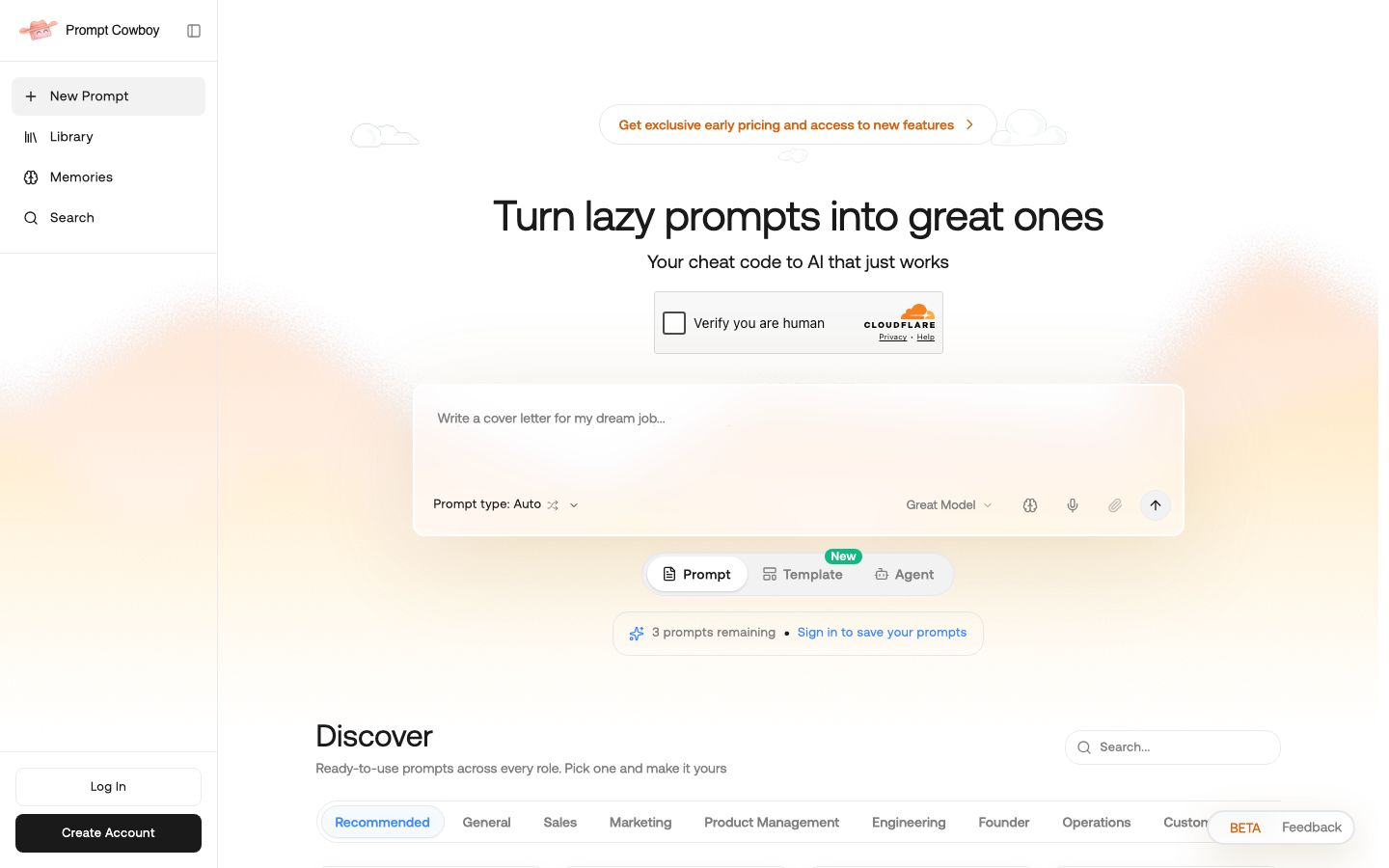
Prompt Cowboy homepage - context engineering for professionals
Visit promptcowboy.ai →

Overview

Prompt Cowboy went from 2,000 weekly users to 55,000 in two months with zero marketing spend. The founders had a product power users loved, customer love so strong that an M&A consultant said it got him "80% of the way there in 10 seconds instead of two to three hours." But they couldn't articulate the why behind the love, couldn't separate free from Pro, and couldn't tell the story to investors. I came in as the marketing strategist to diagnose what was actually working, build the positioning, and shape the narrative that turned customer love into a fundable thesis.

What I Did

  • Diagnosed the real product insight from 1.5M+ prompts. Ran a Top 100 analysis of the highest-iterated prompts. Found that power users weren't just writing better prompts, they were engineering context. Framed the insight as "Context Engineering" and pushed it into the product strategy as the through-line for everything Pro
  • Built the Free vs Pro tier positioning. Free for users who want to write better prompts. Pro for users who want to build intelligent AI systems powered by their own context. Clear value-based distinction, compelling upgrade reason, mapped to real user behaviour
  • Ran the customer research that informed product direction. Interviewed power users across real estate, M&A, strategy consulting, agency, head of product roles. Surfaced the insight that 34% of repeat prompts wanted to become reusable assistants. That insight became the foundation for the Sidekicks feature direction
  • Wrote the fundraise narrative. Built the 15-minute investor presentation script the founders used to pitch the round. Anchored on the 2K to 55K traction hook, threaded customer love throughout, mapped the strategic vision from prompt engineering to captured expertise to platform of expert frameworks
  • Authored the Pro tier go-to-market memo. July 2025 strategy memo defining how Pro should be positioned, what features should anchor it, and how a parallel consulting motion ("Context Engineering Audit") could generate both qualified leads and product feedback
  • Surfaced competitive moat language. Worked with the founders to articulate the iteration-pattern data as Prompt Cowboy's actual moat. Not the model, not the UI, the proprietary dataset of what makes prompts work across millions of iterations. Language the founders carried into investor conversations

Customer Evidence

  • Real estate operator: "You are the GOAT, it changed my workflow with AI overnight"
  • Strategy consultant: "Like having a personal AI coach guiding you to better results every time"
  • M&A professional: "80% of the way there in 10 seconds rather than spending two to three hours"
  • Risk management professional: Compliance reports went from a week to 2-3 hours. "I can use it almost as is"
  • Agency owner: Featured Prompt Cowboy in his presentation to 500+ retail executives

Strategic Insight That Drove the Work

Power users spent 20 minutes per prompt, wrote detailed context, used frameworks. Most people wrote 42 words and wondered why AI sucked. The gap wasn't the technology, it was that most people don't know how to be good AI directors. Prompt Cowboy's job wasn't to make AI smarter, it was to make humans feel smart when using it. That insight reframed everything from positioning to onboarding to the Pro tier roadmap.

Results During the Engagement

2K→55K
Weekly Users in 2 Months
27×
Growth, Zero Marketing Spend
1.5M+
Prompts Analysed
34%
Of Prompts Wanted to Become Reusable

Where the Strategy Compounded

The positioning carried. Today Prompt Cowboy has 350,000 users, 1,000 paying customers, and roughly $132K ARR on a live Pro tier positioned around "for professionals who refuse to compromise on AI quality." That's the direct compounding of the Context Engineering thesis, separating users who want better prompts from users who want a system that thinks with them. The frame I built in 2025 is the frame the product is sold on today.
Delivered

"Context Engineering" positioning framework Free vs Pro tier strategy memo 15-minute fundraise presentation Top 100 prompt analysis + report Customer research synthesis (dozens of power users) Competitive intelligence map Sidekicks feature direction (from "save this and reuse it" insight)

Evidence

Blinq · Senior PMM
Product Launch Integration Co-Marketing

HubSpot App Marketplace Launch: Reshaping a Feature Ship Into a Narrative-Led Launch

Blinq's native HubSpot integration was about to ship as another partner announcement. I reshaped it into a narrative-led launch around the 20-year gap that has sat between the people your team meets in person and the tools they use to follow up. Live on the marketplace, founder video on LinkedIn, customer email to every business admin, and a Co-Catalyst partnership with HubSpot.

Overview

Blinq built a native HubSpot integration so every contact your team meets in person lands in HubSpot the same day, enriched with details, AI conversation notes, and event tags. Ready for follow-up before the team leaves the room. The launch needed to land the marketplace listing, drive installs from existing HubSpot customers, and open a long-term co-marketing relationship with HubSpot.

What I Did

  • Built the marketplace listing from scratch. Benchmarked 6 reference listings (PandaDoc, Calendly, Aircall, Surfe, QuotaPath, Popl) and reverse-engineered the pattern: 5-slide Calendly-style carousel with branded backgrounds, "inside HubSpot" anchored across copy, review velocity prioritised over total count for search ranking
  • Led the storytelling pivot. Three days before launch the plan was a tactical feature announcement. After a strategy session with my manager we reframed the launch around the 20-year CRM gap. Cards and badges became the proof point, HubSpot the first-move example, HubSpot Ventures backing the credibility close
  • Wrote the full launch suite off one narrative spine. Customer email to all business admins, founder LinkedIn post, Blinq company post, team posts for sales and growth leads, internal announcement, sales one-liner, newsletter blurb
  • Directed the founder video reshoot. First cut was feature-led. Refilmed with the CEO the day before launch around the storytelling arc, with hook variants tested on set
  • Owned the Co-Catalyst partnership. Joined HubSpot's Co-Catalyst program, ran the partner-manager relationship, locked a $5K-$15K co-marketing budget commitment with a 3x ROI target, newsletter feature, and self-referral pipeline for existing HubSpot customers
  • Locked launch-day mechanics. Send-time targeted for US business hours, four segmented email campaigns, button routing tied to admin workspace

Challenges and Solutions

  • "Just another integration" framing. Anchored the story on the in-person-to-CRM gap instead of the integration itself. HubSpot became the proof point, not the headline
  • Mixed audience across the launch. Customer email stayed anchored on event lead capture as the most concrete use case. Founder video and social went broader on the relationship-intelligence story so the launch read as company narrative, not a single-feature push
  • Late-stage narrative pivot with the video already filmed. Refilmed with the CEO the day before launch instead of shipping the feature-led cut. The narrative-led version became the founder LinkedIn post and the partner repost asset

Results

  • Customer launch email landed at 3-9x the standard click rate across segments, the highest-converting email Blinq had ever shipped (100 unique clickers from 5,823 sends)
  • 370 marketplace installs in the first two weeks, against a 60-install certification target over six months
  • Co-Catalyst partnership with HubSpot live: co-marketing budget commitment ($5K to $15K with a 3x ROI target), newsletter feature, self-referral pipeline opened

Delivered

Marketplace listing (live) 5-slide carousel + feature screenshots Founder video brief + reshoot Customer email (4 segments) Founder LinkedIn post Company + team LinkedIn posts Newsletter blurb Sales one-liner Internal announcement Co-marketing partnership

Evidence

Blinq · Senior PMM
Product Launch Content Email

AI Notetaker Launch: End-to-End Product Launch With a Consent Challenge

Blinq's AI Notetaker records in-person conversations and saves notes to contacts. Useful for sales reps and networkers, but immediately triggers legal concerns. I ran the full launch: CEO briefing, blog, segmented email campaigns, and paid content strategy.

Overview

The AI Notetaker needed a launch that was honest about what it does and who it's for, without killing the message. The story needed to come from the person who built it. The consent narrative wasn't part of the initial plan, but it needed to be front and centre.

What I Did

  • Ran a briefing session with the CEO to capture his real perspectives: why we built it, the problem with networking today, the relationship context gap
  • Distilled those into talking points he could own (not a script he'd read) for all launch comms
  • Wrote the launch blog post independently: long-form, explains the product in plain language, addresses consent head-on, frames it as relationship intelligence rather than a recording tool
  • Wrote and shipped segmented email campaigns across free users and premium users with A/B variants
  • Identified that AI product ads deliver 2x the return of core product on Meta, initiating a 100-video UGC content program with an external agency

Results

  • Founder LinkedIn launch post delivered 7,400 impressions, 3,073 video views, and 26 seconds average watch time (52 profile views and 5 net new followers off a single post)
  • Paid creative learning loop established: AI feature ads consistently returning 2x core product ads on Meta, redirecting paid budget and unlocking the UGC scaling motion

Delivered

Blog post (live) CEO briefing doc Segmented email campaigns UGC agency brief Paid content strategy

Evidence

Update: Activation Experience (Apr 2026)

Notetaker had strong retention once people used it, but too many users never made it to first recording. We rebuilt the empty state to pull people into the feature on day one: a redesigned activation screen with a brand-team motion video explaining what Notetaker does and how to use it, plus a persistent red dot on the Notetaker tab that stays until the first recording completes.

My role: in-app activation copy and the internal launch announcement to the Blinq team.

Watching: conversion rate to first recording, new users as a percentage of overall monthly active users.

Blinq · Senior PMM
Product Launch Messaging

Campaigns Feature Launch: Solving a Category Clarity Problem Before Writing a Single Asset

Nobody could explain what "Campaigns" did. Not sales, not product, not even a B2B SaaS competitor who tested it. I built the messaging house first, then launched with video, EDM, LinkedIn, and a sales one-pager off one messaging spine.

Overview

Campaigns shipped to public beta but the content team was blocked on the video script and sales needed a one-pager. The real problem: no one could clearly explain what the product did. Feedback from a competitor: "I never understood what campaigns is." This was a messaging problem before it was a content problem.

What I Did

  • Built the messaging house before touching any asset: WHO (champion + company type), WHAT (product category + use case), WHY (problem with current way), HOW (capability + feature), SO THAT (benefit)
  • Created three value prop canvases for three distinct use cases
  • Wrote punch-up copy for headlines and CTAs
  • Briefed the video editor with a 5-beat structure matching the app's actual flow
  • Wrote email and LinkedIn copy off the same messaging spine
  • Built the sales one-pager for the enterprise team

Challenges and Solutions

  • Internal confusion about what the product even does: Started with messaging discipline (WHO/WHAT/WHY/HOW/SO THAT) before any creative work
  • Key objection: "We already have campaigns in Salesforce": Developed response frame: "Blinq does the data cleanup upfront so your Salesforce campaigns actually work"

Delivered

Messaging house Value prop canvases (x3) Video brief (5 beats) Email copy LinkedIn post Sales one-pager

Evidence

eBay Ads · PMM
GTM Strategy Product Launch

GTM Strategy & Launch: From Beta to $180M in Annual Revenue

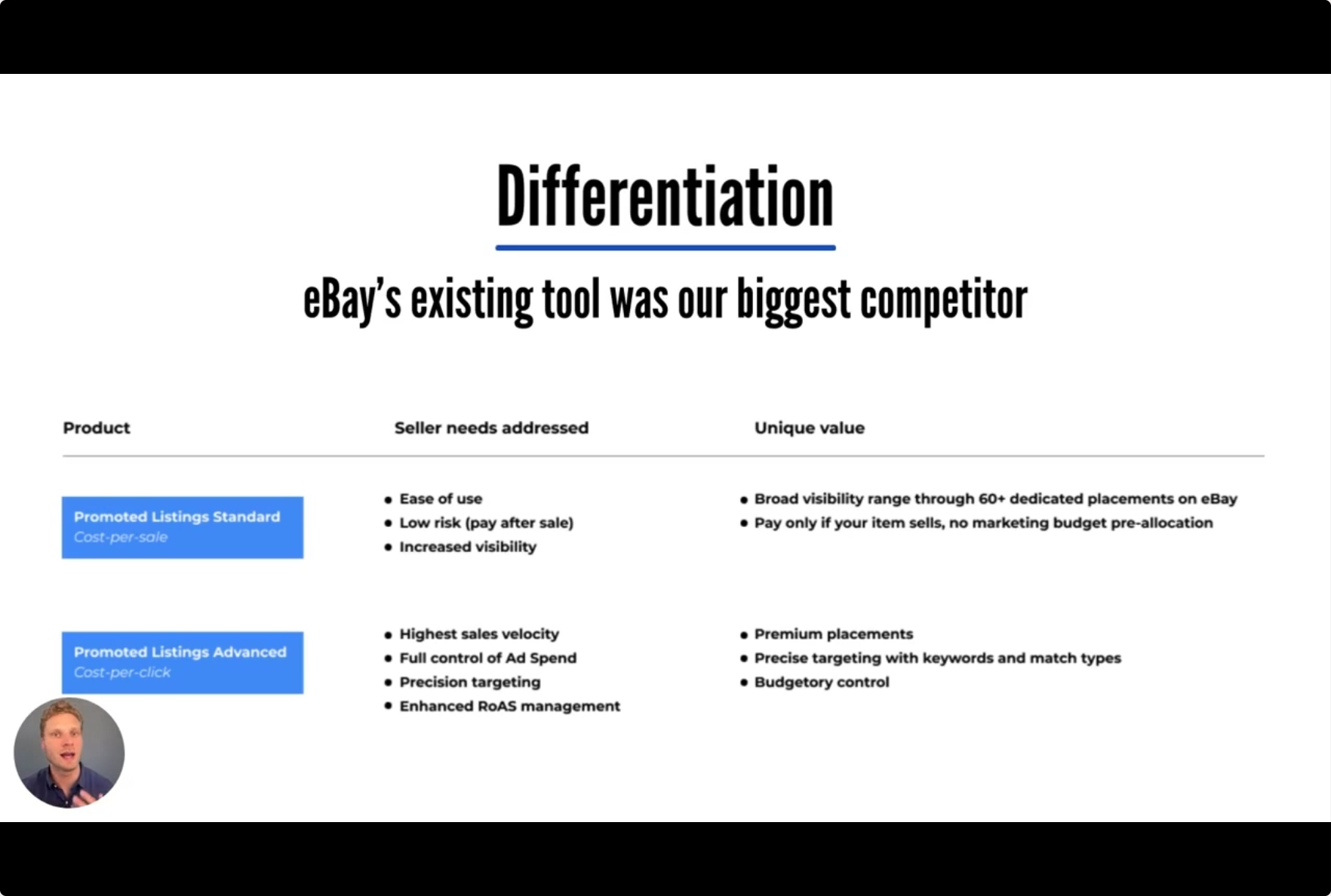
How do you launch unproven ad tech to skeptical enterprise buyers and drive adoption across APAC, US, and EU? I led the launch of eBay's Promoted Listings Advanced from beta to core revenue driver, attracting 2,500+ brands and contributing to eBay's $1B ads milestone.

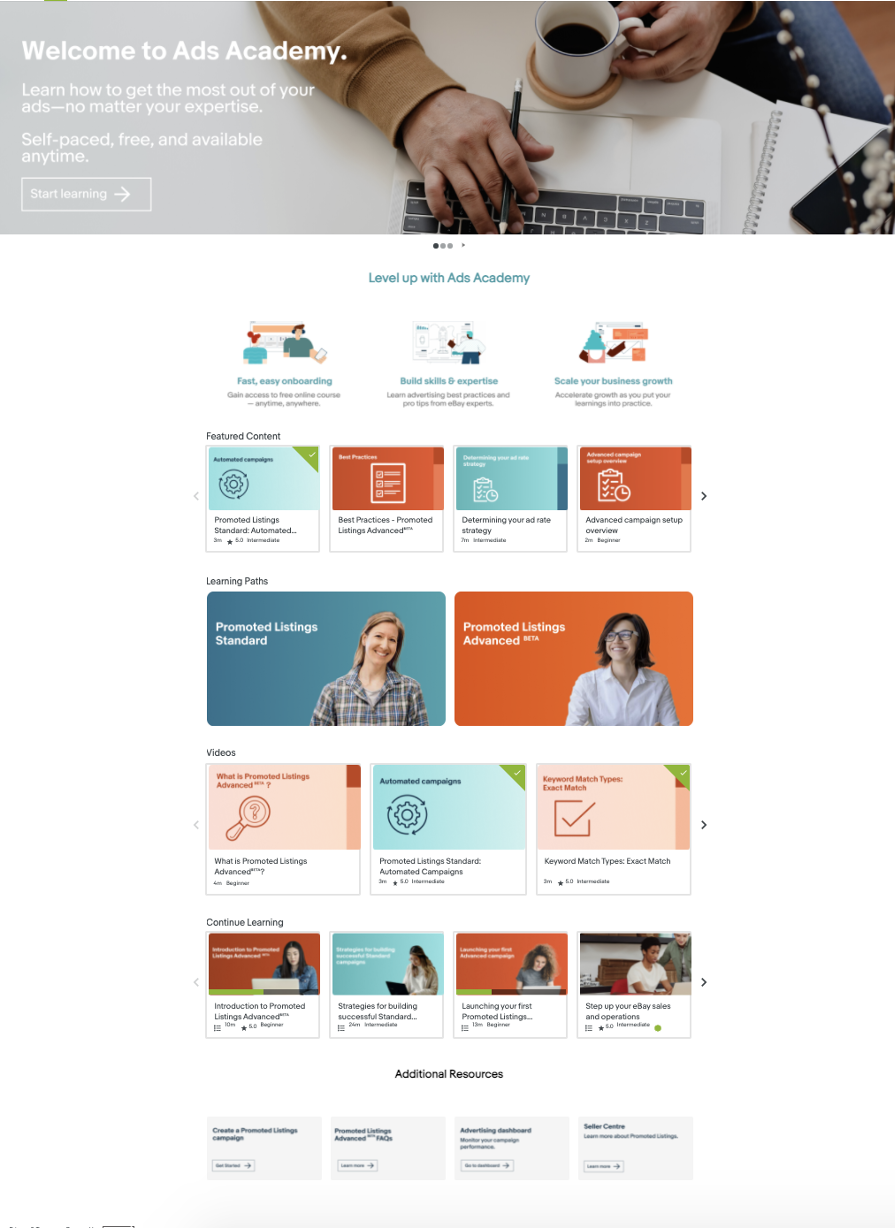
eBay PLA Differentiation slide showing product positioning
Watch presentation recording

Overview

I led the launch of Promoted Listings Advanced, a new advertising product targeting larger eBay sellers and brands. Five products, 2,500+ active brands, $300M+ collective revenue across the ads portfolio.

Process

  • Research: Conducted 20+ in-depth seller interviews and analysed competitor offerings to understand the market landscape
  • Positioning: Developed "Get more sales" messaging, resulting in an 87% increase in click-through rates
  • Product Collaboration: Worked with the product team to prioritise features based on seller feedback
  • Beta Testing: Recruited key brands like Dyson and Nespresso, incorporating their feedback into the final product
  • Sales Enablement: Created an education platform, webinars, and sales materials for the GTM team
  • Global Rollout: Supported teams worldwide in adapting the launch strategy to local markets across APAC, US, and EU

Results

$180M
Annual Revenue
2,500+
Brands Year One
286%
YoY Growth

"That launch exemplified our ability to work without global support, communicating new tools to the market and reeducating sellers on complex concepts. The product evolved rapidly, expanding from just the top spot of search to the whole first page and in-listing pages. This constant evolution required ongoing education of our seller base, adapting our messaging and support as the product grew and changed."

Senior Product Marketing Manager, eBay

NextDocs · Co-Founder
Enterprise B2B Sales

High-Friction Enterprise B2B: $30K Contract Through a 6-Month Compliance Sales Cycle

What does it take to secure enterprise contracts in conservative compliance environments? Built NextDocs for Malaysian ESG reporting and navigated procurement across 20+ public companies.

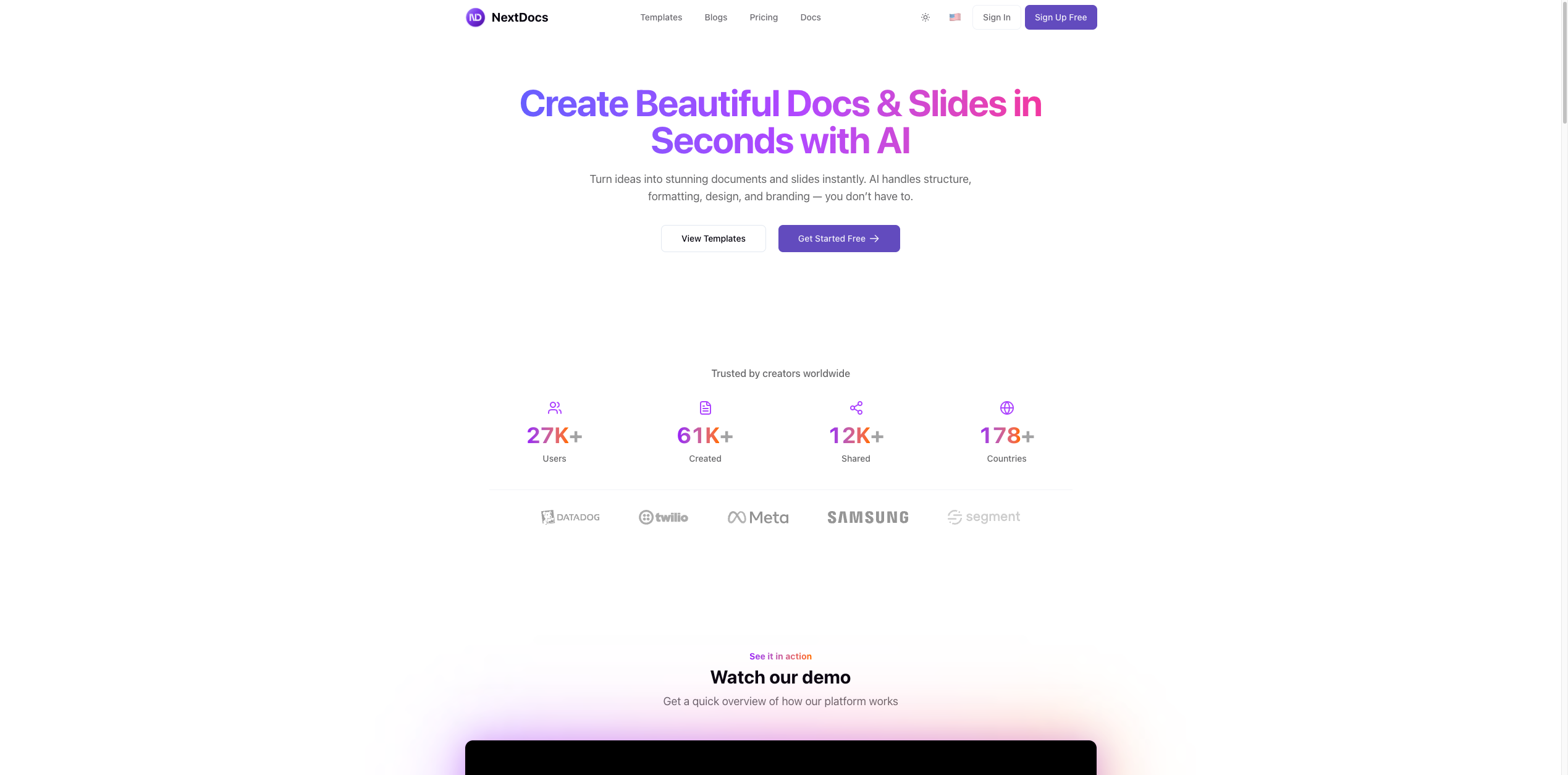
NextDocs homepage - AI document and slides creation platform
Visit nextdocs.io →

My Role & Approach

Co-founder driving enterprise sales strategy and regulatory partnerships.

  • Market Discovery: Identified pain point through direct consulting with Malaysian enterprises struggling with new ESG reporting mandates
  • High-Friction Sales Environment: Navigated multi-stakeholder approval processes across finance teams (data ownership concerns), legal departments (AI liability questions), and sustainability officers (regulatory accuracy requirements)
  • Partnership Strategy: Built consultancy partnership model to access corporate decision-makers
  • Enterprise Contract Negotiation: Secured $30K development contract with Alliance Bank through 6-month sales cycle involving multiple stakeholder committees, legal reviews, and proof-of-concept demonstrations

Results

$30K
Enterprise Contract
20+
Public Companies
3
Partner Consultancies

Evidence

Intelligent Growth · Consultant
PLG Growth Positioning

PLG Growth & Conversion: From 500 Users to $1.2M ARR

You're the first marketing hire at a SaaS startup with a complex product, unclear positioning, and 500 users. How do you find product-market fit and drive 300%+ growth?

Overview

Tasked with figuring out positioning and driving growth for Rephonic, a podcast analytics platform. Complex product with numerous features, diverse target audience, unclear messaging, limited budget, and a 5% trial-to-paid conversion rate.

Development Process

  • Research & Positioning: Conducted 30 user interviews to understand workflows, pain points, and value perception. Identified that technical, feature-focused messaging wasn't resonating
  • Messaging Pivot: Simplified the core message to: "Find the right podcasts to be featured on." A/B tested messaging, achieving a 37% lift in landing page CTR
  • Activation (PLG Tactics): Shifted from limited freemium to free trial. Implemented 7-email onboarding sequence with 45% open rates. Created in-app tooltips reducing time-to-first-value from 12 days to 18 hours
  • Retention & Engagement: Launched weekly email digest with personalised podcast recommendations (increased WAU 40%). Built knowledge base to reduce support load

Results

300%+
User Growth
$1.2M
ARR
5%→12%
Trial Conversion
49%
CAC Reduction

Improved 3-month retention from 60% to 75%. Grew from 500 to 2,000 active users.

eBay Ads · PMM
Partnerships Campaign

Strategic Partnership Adoption: 132x Budget Increase and $250K Revenue From One Webinar

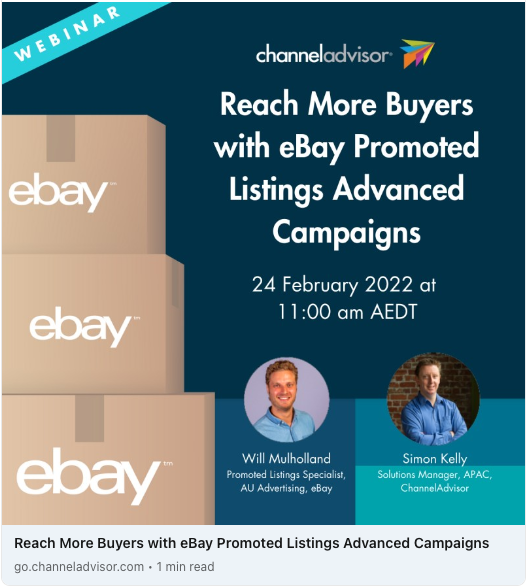
How do you rescue a struggling enterprise integration and drive adoption among 2,000+ potential users? One strategic webinar with ChannelAdvisor drove 50% adoption and $250K in attributed revenue.

LinkedIn promotion: Reach More Buyers with eBay Promoted Listings Advanced Campaigns webinar with Will Mulholland and Simon Kelly

Overview

I led a collaborative webinar with ChannelAdvisor to drive adoption of our Promoted Listings product through their new API integration. Despite having a robust API integration, adoption and revenue among sellers was unexpectedly low.

Key Challenges

  • Low awareness of the API integration among 2,000+ sellers on ChannelAdvisor's platform
  • Complexity and early stages of the Promoted Listings Advanced product
  • Engaging a diverse audience across various industries
  • Balancing technical details with practical insights

Development Process

  • Collaborated with ChannelAdvisor to understand their platform and user base
  • Worked with product managers to ensure accurate feature representation
  • Spoke to sales team to ensure content addressed common seller objections
  • Analysed API usage data with SQL queries and seller pain points to inform content
  • Worked with global legal and Investor Relations to get script and content approved
  • Set clear goals for API adoption, budget increases, and revenue growth

Results

132x
Budget Increase
$250K
Attributed Revenue
50%
Adoption in 1 Year
133
Attendees

Strengthened partnership leading to more joint initiatives including a newsletter.

Evidence

eBay Ads · PMM
Sales Enablement Cross-Functional

B2B Sales Enablement: Enabling a 67% Smaller Team to Sell Complex Ad Tech

How do you enable a 67% smaller sales team to effectively communicate evolving ad tech to sceptical enterprise buyers? Built systematic enablement that drove deeper customer conversations.

Overview

I developed a modular deck to help our GTM team communicate our advertising products to diverse sellers. This was crucial after our sales team was reduced from 18 to 6 members, including 4 new hires unfamiliar with our products.

Development Process

  • Collaborated with product team on weekly syncs to track 15+ feature updates per quarter
  • Worked with marketing to craft messaging, A/B testing key phrases with 200+ sellers before finalising positioning
  • Shadowed 25+ sales calls to identify top 5 objection patterns and co-create response strategies
  • Partnered with analytics to develop key stats and performance benchmarks
  • Engaged customer success to identify and develop industry-specific case studies

Results

  • Sparked more in-depth conversations with sellers at events like RetailFest
  • Enabled sales team to quickly prepare for client meetings and presentations
  • Supported new team members in understanding and communicating product value
  • Served as the foundation for a global sales enablement program

(Slides unavailable due to eBay's privacy restrictions)

"Having all the information in one place made my job easier. I still go back and use those documents from time to time. The content we created for RetailFest led to more one-on-one sessions with sellers. It sparked their interest and gave them a reason to ask more in-depth questions."

Sales Team Member, eBay

"Will was responsible for all sales enablement content for the local team, which was critical to their success. The case studies were particularly impressive, involving a complex process of data collection, seller participation, testimonial gathering, and legal approval. Since new product features were often tested and launched in Australia first, Will had to manage creating the first iterations of that content globally."

Senior Product Marketing Manager, eBay

eBay Ads · PMM
Product Collaboration Cross-Functional

Product Collaboration: Feedback System That Influenced 20+ Product Features

How do you ensure customer insights reach global product teams and drive roadmap decisions? I created the APAC Ads Feedback Newsletter bridging local sellers and global product teams.

Overview

I created and managed a monthly APAC Ads Feedback Newsletter to bridge the gap between APAC sellers and global product teams, ensuring valuable insights were effectively communicated and acted upon.

Impact

  • Directly influenced the product roadmap, leading to 20+ new features including Quick Setup for automating campaign creation and a Campaign Details Page Dashboard
  • Received comments from product and senior leadership including the VP Global Advertising at eBay
  • Increased APAC's involvement in global product meetings and decision-making
  • Improved cross-regional collaboration between product marketing and product development

"The feedback process Will set up through the newsletter helped us get alignment on what we were working on. It was helpful from a product standpoint to get a pulse on user feedback because it gave us a more comprehensive view of what was going on with users. It was valuable because it confirmed hypotheses we had, particularly around features like Quick Setup."

Senior Product Manager, David Lyons, eBay

"The newsletter Will built was valuable for building relationships with leadership and product globally, putting our team on the map, and creating a structured feedback loop. It set the foundation for future product improvements."

Senior Product Marketing Manager, eBay

Ogilvy · KFC Australia
Viral Campaign Product Discovery

Earned Media Strategy: 460M Impressions With Zero Marketing Spend

KFC's mobile app had 20% retention with zero marketing budget to fix it. I turned staff menu hacks into a hidden discovery feature that required holding the app logo for 11 seconds to unlock. Users created 1,000+ tutorials teaching each other how to find it.

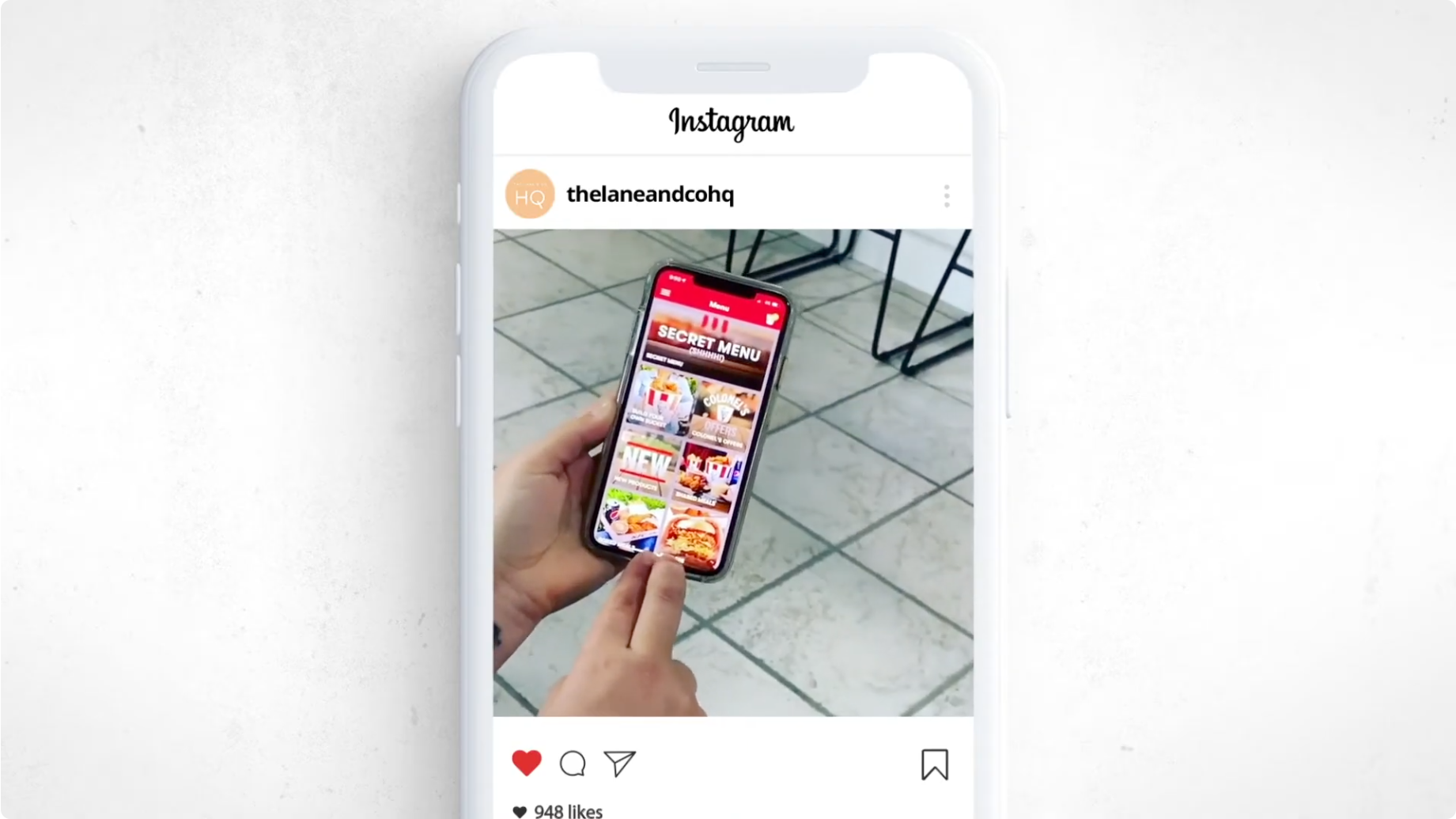
KFC Secret Menu campaign case study
Watch campaign case study

Overview

At Ogilvy for KFC Australia, the mobile app had 20% retention. Users downloaded for discounts then deleted immediately. Zero marketing budget to fix it. I discovered frontline staff creating unofficial menu items internally (like "Beese Churger," "Nug-a-Lot"). The creative team proposed hiding these behind an 11-second logo hold tied to "11 herbs and spices."

What I Did

  • Coordinated the campaign execution and wrote the discovery seeding strategy
  • Wrote cryptic hints buried in app T&Cs: "Secret Menu available for those who know where to look"
  • Created the breadcrumb trail across channels: edited 6-month-old YouTube comments with vague clues, coordinated hiding hints in email footers and split-second digital billboard frames
  • Worked with product team on the unlock flow and interface copy
  • Briefed photographers on menu item styling to look exclusive and shareworthy
  • Designed the measurement approach tracking social mentions and app session patterns

Challenges and Solutions

  • Staff weren't app advocates: Made them co-creators by featuring their menu hacks. Staff became natural promoters showing customers their creations
  • Zero budget for paid discovery: Treasure hunt mechanics made early users feel like insiders who wanted to teach friends, creating organic tutorial content

Results

61%
Retention (9+ months)
$1.1M
Revenue, 6 Weeks
460M+
Organic Impressions
111%
Download Increase

67% of Secret Menu orders included additional full-price items. $0 media spend.

Other Assets on Request

Enterprise 2-pager HubSpot marketplace listing Welcome email series Competitive battlecard AI Notetaker messaging house ELC launch email series
wcmulholland@gmail.com
🔒

Work samples are private

Leave your email and I'll send you the password.

already have it?